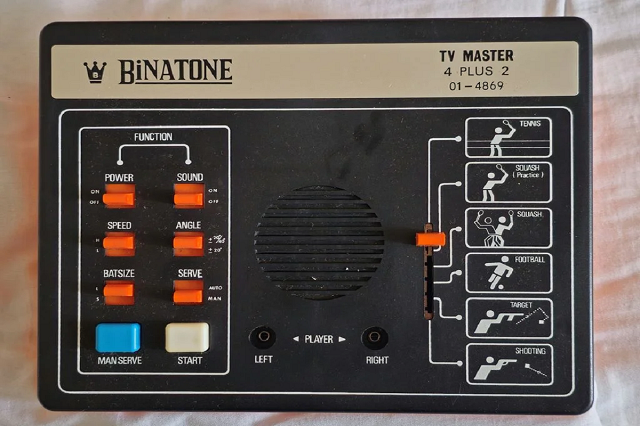
 The Binatone TV Master 4+2
If there is one thing we were good at in our house, it was being at the bleeding edge of technology. Well, maybe not the bleeding edge, but pretty close to the edge. You could certainly see the edge from where we were.
One such item of "kinda near the edge but not too close" technology we had was a Binatone TV Master 4+2. Oh yes, I know what you are all thinking, and yes, we were that cool (or at least everyone else in my family, I wasn't even born when this came out).
Yes, the speech marks around console are on purpose and I will explain.
Pong!
Before we get to the TV Master allow me to talk about Pong!
Pong is a game that took the world by storm. For those of you who don't know what Pong is, I have to question where you've been living? But because I am a kinda nice guy I will explain.
Pong is an incredibly simple idea. You have two rectangles that you can move up and down the screen. You have a small square which moves left and right across the screen.
The idea is that the two rectangles are the paddles off which you bounce the small square, or ball I guess it's meant to be.
 Screenshot of the orginal Pong
Allan Alcorn developed the idea in 1972 while he was working for Atari. At this point arcade machines were still very much associated with mechanical pinball-style machines, so when the new Pong arrived it was a revolution.
Sadly (well, for Atari anyway), Atari didn't patent the game idea and within months the market was flooded with Pong machines.
I mentioned this history because that is essentially what the TV Master was.
It was a Pong machine, albeit with a few extras.
Pong but not Pong?
See at the heart of the TV Master 4+2 was a General Instrument AY-3-8500-7 integrated circuit.
 General Instrument AY-3-8500-7
This was a dedicated video game chip that was known as a Ball & Paddle chip. It contained the logic for (you might have guessed) 6 games inside its circuits.
There was no CPU inside the TV Master. It didn't need one (and CPUs weren't exactly cheap or readily available for something like this anyway).
All the logic and circuitry needed to keep track of things such as the ball's position, generate the bats and produce the television signal was built into the dedicated game circuitry. The really intresting thing is how.
Scan Lines
The TV Master didn't have an onboard graphics card that you would see in a console today. It produced (via an RF modulator) an actualy analogue TV signal which the TV then turned into the graphics on the screen.
Because of the way CRT televisions worked they constantly drew the picture from top to bottom, line by line. These were known as scan lines.
The chip onboard the TV Master knew which part of the scan line the TV was, and generated the appropriate signals at the appropriate moment.
Want to draw the ball?
Generate the signal when the television reaches the ball's position.
Want to draw a bat?
Generate the signal when the television reaches the bat.
Want a white line down the middle of the screen?
Generate a signal at the appropriate point on every scan line.
It might sound ridiculously primitive compared to modern graphics, but it was actually a very clever way of doing things. It also meant that as long as the TV was setup to recieve the correct format (PAL in the UK) then it would work on any size television as it was the television itself doing the job of turning those electrical signals into an image rather than using a dedicated graphics chip.
And there were six games
The name 4+2 wasn't just marketing nonsense... Well, maybe a bit.
We know the chip has six games on it. Four of games were variations on the Pong idea, Tennis which was Pong basically, Squash which was pong agaisnt a wall and Football (it was called hockey in America) was pong with a target to hit at.
You could claim they were literally the same basic idea with just enough difference to claim four games but I wouldn't because that would be mean I don't do mean.
Oh, and there were the two shooting games, which used the light gun.
These were extremely basic games consisting of basic shapes and movement. That's of course when the light gun actually worked, it tended to have a mind of its own.
And there was light (gun)
When the gun did work, it was pretty cool. Shooting at thing on the screen is always fun, getting to do it with a gun is extra cool.
The light guns themselves were actually pretty clever bits of kit, as it isn't immediatly obvious how they worked.
There was no camera inside it, nor did it use motion tracking like the Wii. Instead, the end of the gun contained a light-sensitive component.
So when you pulled the trigger, the console could use the timing of the television's scan together with the light detected by the gun to determine whether you were pointing at the target.
Now for years this actually confused me, until one day it just seemed to click. If you already understand then good for the rest of us:
Remember those scan lines that are drawing the picture on the screen? We know the television is drawing the picture incredibly quickly, one line at a time.
When the scan reaches the area where the target is being displayed it produces a slightly brigther point on the TV screen.
The sensor in the gun only sees a small area of the screen. So if it detects the target's light when you pull the trigger, the console can register that as a hit. As it is assumed the gun was pointing at the target.
This is also why these original light guns only worked properly with CRT televisions.
Modern LCD and LED televisions work very differently and don't have the same kind of scanning beam that the old CRT relied upon.
The controllers weren't rocket science
Even the controllers were incredibly simple. They had a simple dial on them which moved the paddle up and down. There wasn't a need for anything else after all, and they worked.
There was nothing complicated between the controller and the logic onboard the chip. You turned the dial, the electrical signal changed, and the paddle moved. That's pretty much it.
Was it a console?
Well... sort of.
It certainly used digital electronics, but calling it a console (or a computer) in the modern sense is probably stretching the definition.
It was a dedicated electronic machine designed to perform a particular task and, while it did do that, that was your lot.
You couldn't add new games.
You couldn't write your own.
You couldn't load software.
What you got was what was built into the hardware.
Memories
I have memories of playing on it, but to be fair it was a bit "old hat" by the time I could appreciate what it actually was.
I just remember it being around the house and being a bit of fun to play on.
Weirdly (although probably not for me), I actually enjoyed playing with the paddles and the machine switched off, pretending it was the controls for my spaceship.
At £13.99 (about £100 in today's money), it was an inexpensive way to bring home a bit of arcade fun, and it sold a lot of units, so many in fact that multiple version were released that added more games.
When you think about what was actually inside that little box, it was pretty clever.
No CPU.
No operating system.
No game cartridge.
No graphics card.
Just some electronics, a dedicated game chip, a couple of controllers, a light gun and your television.
And somehow, it turned all of that into Pong.
The Magnavox Deal
When I was researching this article I came across the orginal box for the TV Master and there in the corner was "liecnsed by maganvox".
Binatone wasn't simply copying Pong and hoping nobody noticed. The TV Master was produced under licence from Magnavox, which held important patents relating to the early home video game technology developed by Ralph Baer and his team.
This is one of those weird arears of retro gaming that can get quite confusing. While Atari owned and created Pong, they had to pay Maganvox for essentially infringing on their Paddl and Ball game technology.