 The Binatone TV Master 4+2
In the late 1960s, IBM had a problem. The computers they were designing used RAM to store instructions. The problem is that RAM is volatile. I don’t mean it can punch you for no reason; I mean that once the computer was turned off, anything stored in RAM disappeared.
What IBM needed was somewhere for those instructions to be permanently stored. Their idea was a cheap device that could read instructions, along with a cheap, removable medium containing them. That way, when the computer was switched on, it could read the instructions from the medium and load them into RAM.
When 8 is Enough
Alan Shugart, who managed IBM's disk storage products, gave engineer David Noble the job of finding a solution. Initially, Noble used magnetic tape, but he couldn't make it work reliably enough.
Tape is an awkward medium, and it was serial access, meaning to get to a piece of data, you would need to move through the tape. Tape also had the issue of tending to stretch and collect dirt, both of which made reading the data impossible.
The project was then handed to another IBM team. Instead of tape, they came up with a new idea: a flexible magnetic disk.
Magnetic disks were not a new idea; they already existed and had been used by IBM since the 1950s, but they were huge, rigid, and heavy. The IBM 350 Disk Storage Unit, from 1956, for example, was enormous. It contained 50 large metal disks, each about 24 inches across.
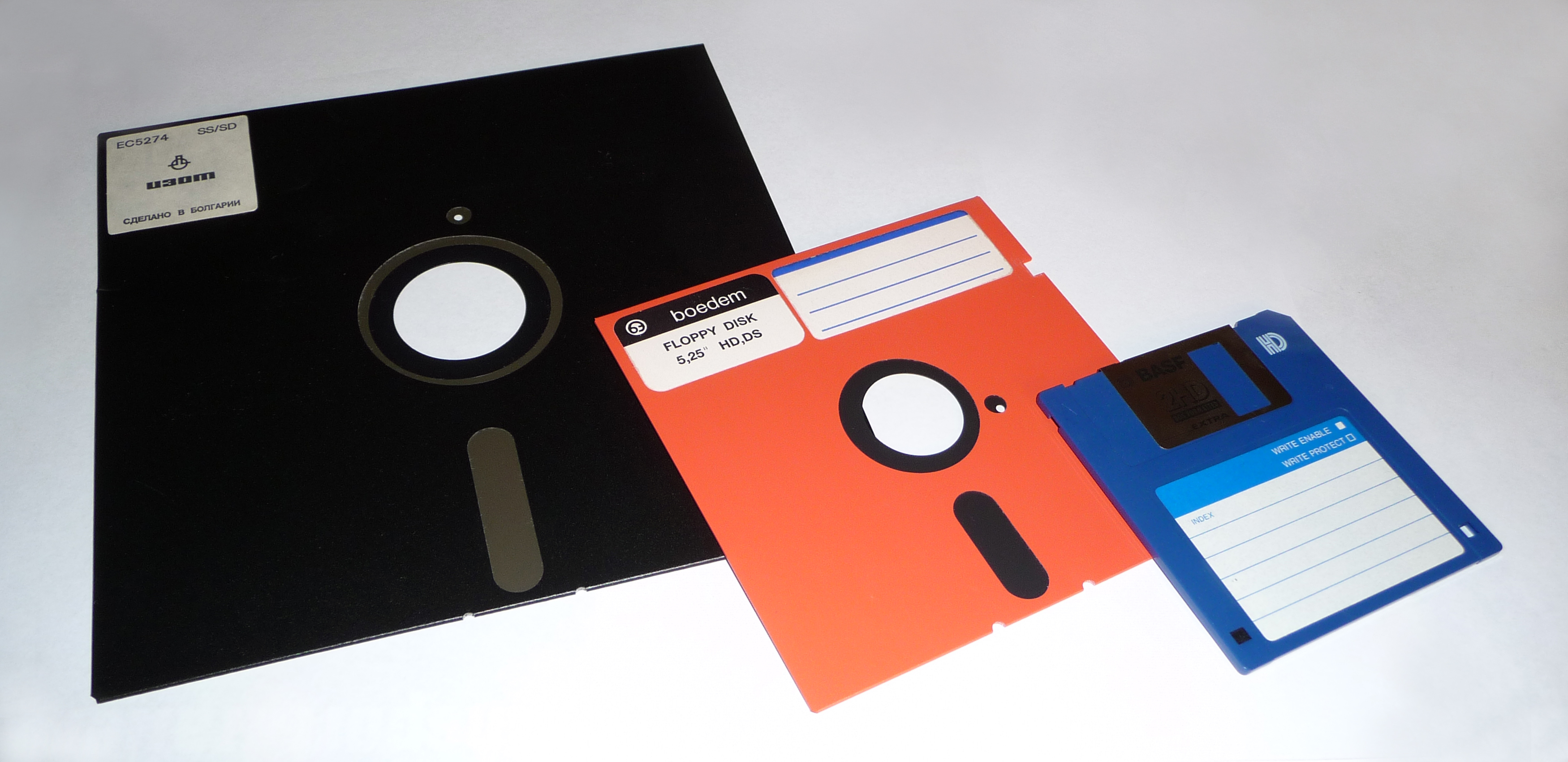
The new flexible disk was 8 inches and held 80KB of data. Originally, the disk was completely exposed, and as you can imagine, dust and dirt quickly became a problem. Even small particles could interfere with the disk and cause reading errors. The solution was to put the disk inside a plastic envelope lined with a fabric that helped remove dust from the disk as it spun.
In 1971, IBM unveiled their new "flexible disk," and it was a hit. Remember that this was 1971; computers weren't mainstream or even "second-stream" (is that a term?). The original purpose of the disks was to make it easier and cheaper to load software, replacing tape reels and punch cards.
The original disks were read-only; you couldn't write to them. This became a problem when people began to realize how useful it would be to save information to the disks to facilitate computer-to-computer transfers. The reason they were originally read-only came down to the original brief: they were only meant for the transfer of software, not data. In 1973, IBM produced the first read/write disks, allowing everyday users the ability to use the medium to move and save data between computers.
Smaller is Better
The next major step in floppy disk history came from Shugart Associates (that is Shugart, of IBM fame, who left IBM to set up Shugart Associates). One of their big clients was Wang Laboratories. Wang was an American company that made desktop word processors, and they wanted something smaller than an 8-inch drive. The 8-inch drive was a large and bulky device, and they wanted something sleeker and smaller for their machines.
What they created was the 5¼-inch disk. The smaller disk was cheaper and much more practical for what Wang wanted. Luckily, manufacturers of personal computers, which in 1976 were starting to become a big thing, also saw the benefit of smaller drives. As machines such as the Apple II, Commodore PET, TRS-80, and later the IBM PC appeared, 5¼-inch disks became one of the main ways people stored software.
There are two urban legends attached to the reason behind the 5¼-inch size. The first says it was designed to fit on a paper napkin that was 5¼ inches in size, and the other claims it was chosen because it was just too big to fit into a shirt or trouser pocket, preventing the disk from being bent. Neither is true, sadly.
Enter Sony
The 5¼-inch disk was the standard for a long time, but in 1981, Sony released the 3½-inch floppy disk. It was smaller (obviously) than the 5¼-inch, which meant the device to access it was also smaller. This was a big advantage as computers were coming into the home, where space was a premium.
Despite its name, it was no longer floppy. Sony noticed that a big problem with the 8-inch and 5¼-inch formats had actually been the floppiness of the disks. They could be bent and creased, and because there was a large window in the casing for the device to read the disk, they could be easily marked.
The new 3½-inch disks were designed to be more robust. With a hard plastic shell, they could no longer be bent (well, not easily). The window for the disk to be read was also much smaller, and more importantly, it had a protective metal cover that slid back when the disk was inserted into the drive.
Apple quickly adopted the format, and many others followed. IBM would eventually adopt it too, and during the late 1980s and 1990s, the 3½-inch floppy became the standard removable storage medium for PCs.
The 3-inch Floppy
Around the time Sony launched the 3.5-inch, Alan Sugar was designing the new CPC range. Sugar wanted to keep things cheap, and so, although Sony's 3.5-inch drives were just emerging, they were expensive. Luckily for Amstrad, Hitachi was launching its own disk system: the 3-inch.
Because Amstrad was able to get a good deal with Hitachi, the 3-inch became the Amstrad standard. While the popularity of the 3-inch disk didn’t take off as Hitachi would have liked, it didn't stop the sales of the Amstrad machines. Both CPC and PCW models used the system, and both ranges became very popular. The rest of the world, though, had embraced the 3½-inch.
Well, almost…
Tatung Einstein — a British-designed Z80 computer with one or two built-in 3-inch drives.
Oric-1 / Oric Atmos — 3-inch drives were available for these machines.
Timex/Sinclair — used 3-inch drives in some systems, including the FDD-3.
Yamaha MDR-1 — a Japanese music-related machine that used 3-inch disks.
Matsushita National Mybrain 3000 — a particularly obscure Japanese computer using the format.
Perhaps the most bizarre (certainly when looking at it today) was SEGA, which also used the 3-inch format in their SC-3000 computer. You didn’t know SEGA made computers? Now you do.
Alas, Farewell…
By 1991, the 3½-inch disk had grown in capacity from 218.8KB to 1.44MB (with a stop at 720KB along the way).
But manufacturers don’t like to let a good design die, and they tried to squeeze more life out of the floppy concept.
SuperDisk (LS-120) — a 120MB disk; its drive could also read and write ordinary 3½-inch floppy disks.
HiFD — Sony's attempt to create a high-capacity floppy that could hold around 200MB while remaining compatible with ordinary floppy disks.
There were also numerous proprietary formats used by individual computers and specialist equipment. Some succeeded; most didn't.
The End
By the late 1990s, CDs were becoming cheap and offered vastly more capacity. When CD-R/RW came along, it signaled the death of the floppy disk. Eventually, USB flash drives did the same to CDs, and later, we got cloud storage.
When Apple famously removed the floppy drive from the iMac G3 in 1998, despite the fact that floppy disks were still widely used, it was probably the moment the industry started accepting that the floppy's days were over.
Except they didn't vanish entirely. Floppy disks continued to be used long after modern computers stopped having floppy drives. Some industrial machinery, aircraft systems, synthesizers, embroidery machines, and other specialized equipment continued using them because “it works” is a surprisingly powerful argument against replacing old technology.
In the end, floppy disks might be around for a long time, or at least until someone upgrades the drives on the Boeing 747s.