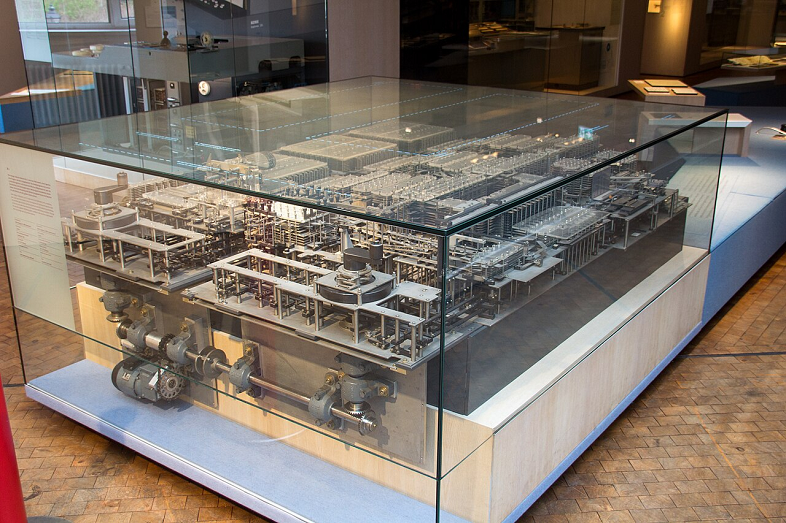
Imagine telling your parents that you're going to build a computer. Not buy one, build one, and not build as in, buy the ready-made parts and put it together. No, you are telling them that you are building the whole thing from scratch.
Oh, and it’s 1936, and computers as we know them today don’t exist, so you will need to design and build every part yourself. I would imagine most parents would probably smile politely and suggest finding a more sensible hobby like trainspotting or Subbuteo.
Konrad Zuse’s parents didn't. Instead, they helped him clear a space in their Berlin apartment.
Who Was Konrad Zuse?

Konrad Zuse was born in Berlin, Germany, in 1910. At school, he had a dislike of maths (because he was normal) but loved drawing and art. He used to doodle steam locomotives and other machinery in the margins of his books. He used to build amazing bits of machinery using his Stabil metal construction set (think Meccano, but German). Basically, Konrad Zuse was me as a child, but with the parents who would have let me take over the whole living room.
After studying civil engineering at the Technical University of Berlin, Zuse found work as a structural engineer. On paper, it sounded exactly like something Zuse would enjoy doing. Looking into the bones of how buildings were built and ensuring they would stay up.
Unfortunately, what it actually meant was a lot of maths, and we know that Zuse was not a fan. Mechanical calculators did exist and generally they were faster at calculations than a person using pencil and paper, but they still depended on a human operator to enter the numbers and repeat operation after operation.
What Zuse wanted was a machine where he could input a problem and let it work through the steps by itself, and eventually produce an answer. Today, you could probably get a spreadsheet to produce these results in seconds, but in 1933, the idea was bordering on science fiction.
But Zuse wasn’t the sort of man who gave up, and he really hated maths. Thankfully, he had parents who were surprisingly tolerant of their son taking over the apartment they lived in with a mystery machine.
Building the Z1
Working largely alone, with limited money and no government funding, he set out to design and build his machine. Now, remember this is in 1936, so there were no computer parts because there were no computers. Everything Zuse would need, he had to design and build himself. Which he did, building everything from thin sheets of metal, pins, rods, levers and sliding plates.
When it was finished, the Z1 contained around 20,000 individual parts. Imagine trying to build a Lego set with that many parts and no instruction manual. Oh, and you would need to design and build the Lego pieces first as well, because for Zuse, every single one of those parts had to be designed, manufactured, assembled and adjusted by hand. No CAD software. No laser cutters or 3D printers. If a part didn't fit properly, Zuse had to reshape it himself.
The Z1 slowly grew inside his parents' apartment, occupying more and more space as new sections were added. It wasn't unusual to find pieces of precision engineering lying on the sofa or on the coffee table. We should, of course, give huge amounts of praise to Mrs Zuse, who clearly was proud of her son and was able to resist the temptation that all mums have of tidying up.
Why Binary?
One of the really interesting design features of the Z1 was the use of binary.
Today, that is the standard way for a computer to work, but in 1936, it probably seemed a bit odd. Earlier calculating machines had been built around decimal numbers; after all, it’s what humans use.
The thing about mechanical parts is that they are really good at doing one thing or another. A switch can be up or down. A lever can be left or right. A metal plate can be pushed forwards or pulled backwards.
Now try to build a mechanism with ten perfectly reliable positions. It’s difficult, but building one with two positions is much easier. Instead of asking a tiny mechanical part to recognise ten different numbers, Zuse only had to decide whether it was in one position or the other.
Zuse realised that complicated numbers could be built from simple pieces. Just as the alphabet creates thousands of words from only twenty-six letters, binary can represent any number using nothing more than ones and zeros.
Again, this was in 1936. Zuse came up with these ideas himself. He couldn’t pop onto YouTube for a how-to video on binary maths or ask for help from some random genius in India via Stack Exchange to help him. He did it himself.
Floating-Point Numbers
While the Z1 was impressive in itself, it actually did something even more amazing. It could work with floating-point numbers.
What, I hear you cry, is a floating-point number?
Let's assume someone asks you for the distance between the Earth and the Moon in metres. After you call them weird for asking such a bizarre question, you tell them it’s 384,000,000 metres (because you just happen to know).
Instead of writing down every digit, you can actually store the number in a kind of scientific shorthand. What you essentially want to do is turn the number into a number between 0 and 9.
In this case, it's 3.84. Count the number of movements the decimal place has made; in this case, 8.
What you end up with is 3.84 × 10⁸, which is basically:
3.84 × 10 × 10 × 10 × 10 × 10 × 10 × 10 × 10
This might seem really easy, but imagine building a machine out of metal plates, rods, levers and springs that has to:
- Store 3.84
- Store the 8
- Move the decimal point according to the exponent
- Add, subtract, multiply and divide numbers with different exponents
- Keep the result in the correct form
- Deal with numbers that are extremely large or extremely small
And Zuse was doing this mechanically. This wasn’t a simple, “Oh, I will just add this feature.” This required some serious planning.
Why did Zuse need this, you might ask? Remember, this computer was designed to work out engineering calculations, and engineers seldom work with whole numbers. Having floating-point meant the Z1 could work with the calculations it needed directly.
What is really amazing is that Zuse included floating-point arithmetic in the Z1 nearly a century ago. Many of the home computers from the 1980s relied on software to handle floating-point calculations because the hardware wasn't capable of doing it efficiently. Yet here was a machine built from metal plates, levers and springs already tackling the problem.
The Z1 wasn't identical to a modern computer, but the basic idea was there.
It Could Run Programs
Even more remarkably, it could read a sequence of instructions from punched film. Once loaded, the machine followed those instructions automatically instead of waiting for someone to tell it every step. In other words, it could run a program. That was an extraordinary achievement.
When historians describe the Z1 as being ahead of its time, they aren't exaggerating. Hidden inside this rather clumsy-looking mechanical machine were ideas that would define computing for the next hundred years.
Unfortunately, having brilliant ideas is one thing; actually turning them into a reliable machine is quite another.
The Problem With Building a Computer From Metal
Imagine a line of dominoes. Push the first one, and each domino knocks over the next until the movement reaches the end.
The Z1 worked in a similar way, except instead of falling dominoes, it used carefully controlled movements of tiny metal components. A single movement in one part of the machine could trigger dozens of other movements elsewhere, allowing numbers to be stored, compared and manipulated.
The problem is that metal expands slightly with changes in temperature. Although tiny, the imperfections caused parts to stick. Springs also have a tendency to weaken after lots of movements. A component that worked perfectly on one calculation might jam on the next.
Now, remember that the Z1 had 20,000 individual parts, and you should have some idea of the huge challenge Zuse faced just running the machine.
By 1938, after two years of painstaking work, the Z1 was finally running and was capable of carrying out calculations automatically. It wasn't fast by modern standards, but it proved that Zuse's remarkable idea could work.
Sadly, the Z1 was really unreliable and was near impossible to build on a large scale, but for Zuse, it proved that what he wanted was possible. He just needed to rethink parts of it.
From Z1 to Z3
Zuse created the Z2, which used old telephone relays instead of pure mechanical parts. This helped to improve the reliability of the machine.
Then, in 1941, Zuse completed the Z3, a computer that many historians consider to be the world's first fully operational, programmable, automatic digital computer.
Sadly, Germany was at war, and so Zuse's work remained largely unknown. The Allies had researchers developing their own computers in complete isolation, unaware that a German engineer had already solved many of the same problems they were facing.
Zuse would continue developing machines and ideas throughout his whole life. In a rather lovely (well, I think) callback to his childhood, Zuse would go back to his love of art and create some wonderful paintings.
The Z1 Returns
Today, sadly, the original Z1 no longer exists. The machine was destroyed during a bombing raid during the Second World War.
However, in the 1980s, Konrad Zuse undertook an extraordinary project. Working from his surviving notes and memories, he rebuilt the Z1. The reconstruction is now on display at the German Museum of Technology in Berlin, allowing visitors to see just how ambitious the original machine really was.
The Computer That Pointed the Way
The Z1 didn't become a commercial success. It wasn't copied around the world, and it didn't launch a computing revolution overnight.
But the history of computing isn't just the story of the machines that won. It's also the story of the machines that showed everyone else what was possible. The Z1 was one of those machines.